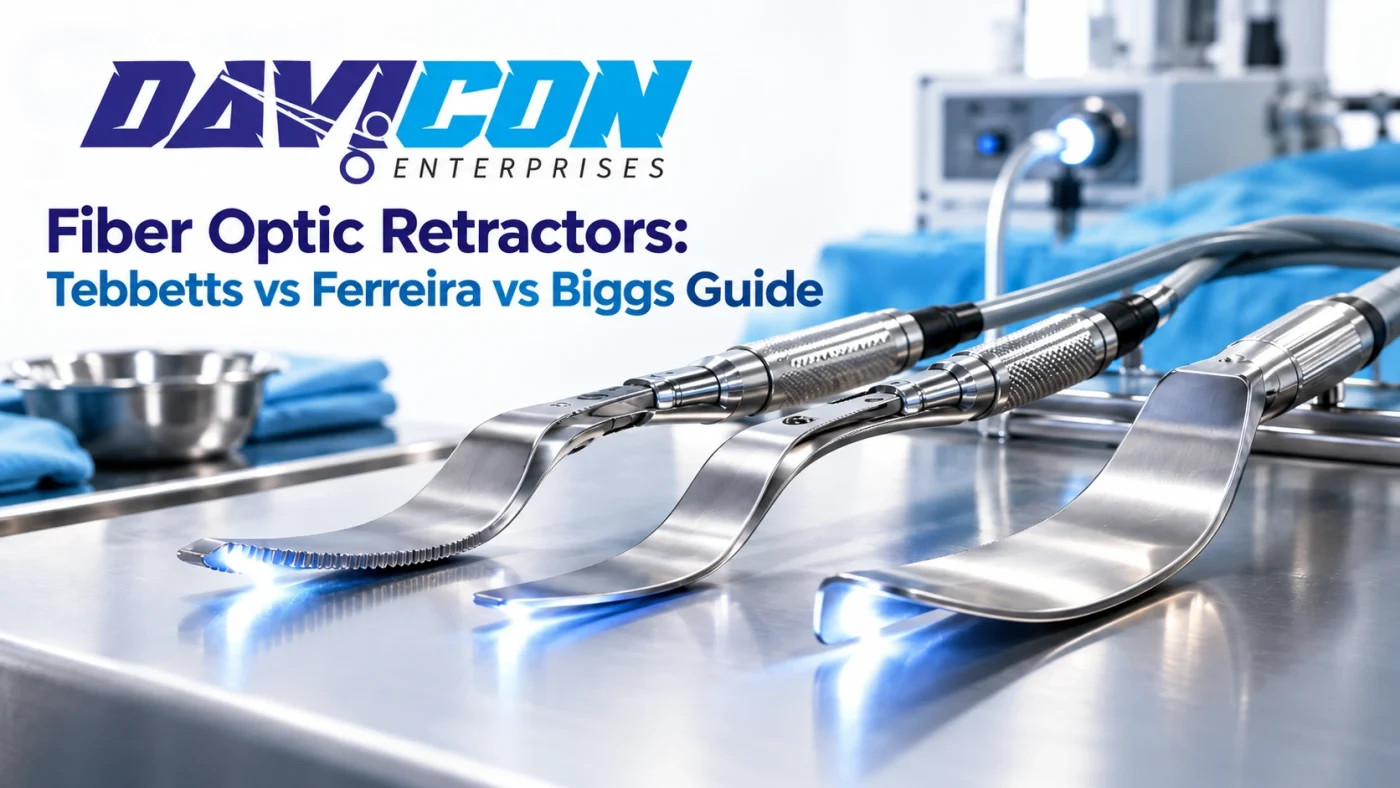
Good surgery starts with a clear view. In breast and face procedures, surgeons often work through small cuts that lead into deep, narrow spaces where overhead lights cannot reach. This is where fiber optic retractors make a real difference. They hold tissue back and shine bright, cool light straight into the working area at the same time. At Davicon Surgical, we have made and exported plastic surgery instruments since 2000, and we see the same question again and again from surgeons and buyers: what is the difference between Tebbetts, Ferreira and Biggs retractors? This guide answers it in simple words. You will learn how each design works, which procedures it suits, and what to check before you buy.
Quick Answer: Tebbetts retractors have angled blades, usually with a serrated tip, and are the most common choice for breast augmentation. Ferreira retractors have a smooth-ended blade that glides gently through tissue, which suits augmentation and endoscopic work. Biggs retractors have wide blades for holding large tissue flaps in breast reduction, breast lift and facelift surgery. All three are available with fiber optic light.
What Are Fiber Optic Retractors?
Fiber optic retractors are hand-held surgical retractors with a built-in light guide that carries light from an external light source to the tip of the blade. They do two jobs at once: they hold tissue apart and they light up the surgical site.
How Fiber Optic Retractors Carry Light to the Surgical Site
The system has three parts:
- Light source: a box in the operating room that produces strong light (xenon, halogen or LED).
- Light cable: a flexible cable filled with thin glass fibers that carries the light.
- Light guide: a rod or channel fixed along the retractor blade that sends the light toward the tip.
Light travels through the glass fibers by bouncing along the inside walls, so very little is lost on the way. The result is a bright beam right where the surgeon is looking, without the shadows that come from overhead lamps or headlights.
Why Surgeons Choose Lighted Retractors with Suction
Many models also have a suction tube along the blade. During surgery, electrocautery creates smoke inside the pocket, and that smoke can block the view. The suction tube removes the smoke as the surgeon works. Light and suction together mean fewer pauses, a cleaner field and less need for an assistant to hold a separate light or suction tip.
Key Parts and Features of Fiber Optic Retractors
Before comparing the three types, it helps to know the features that set one model apart from another.
Blade Width and Length
Sizes are usually written as width x length, for example 36 mm x 150 mm. Width controls how much tissue the blade holds back. Length controls how deep it can reach. Narrow, short blades suit small incisions near the surface. Wide, long blades suit deep breast pockets and large flaps.
Serrated Tip vs Smooth Tip
A serrated (toothed) tip grips tissue so the blade does not slip, which helps when lifting heavy tissue. A smooth tip slides in and out gently and is less likely to catch on delicate tissue.
Light Guide and Suction Tube
Some retractors come with light only, some with suction only, and some with both. Some also have a replaceable light guide, which means you can swap the light part if it gets damaged instead of replacing the whole instrument.
Insulated Blades
An insulated blade has a non-conductive coating, often black or colored. It helps protect nearby tissue when the surgeon uses electrocautery close to the retractor.
Light Source Connectors
The cable must fit both the light source and the retractor. Common connector types include Storz, ACMI, Wolf and Olympus. Many retractors use a universal adapter, but always confirm the fit before surgery.
Tebbetts Fiber Optic Retractors: Design and Best Uses
The Tebbetts is the best-known design among fiber optic retractors for breast surgery. It has an angled handle that gives the surgeon a comfortable grip and keeps the hand out of the line of sight. The blade usually has a serrated tip that holds tissue firmly, although smooth-tip versions are also made.
Main features:
- Angled blade and handle for a clear view into the pocket
- Serrated tip for a firm hold (smooth options available)
- Light guide, often with a suction tube for smoke removal
- Wide range of sizes, from small blades for short incisions to long blades for deep pockets
Best uses:
- Creating the implant pocket in breast augmentation
- Breast lift with implants
- Implant exchange and revision surgery
- Other deep soft tissue work
Davicon Tebbetts options include:
Ferreira Fiber Optic Retractors: Design and Best Uses
The Ferreira retractor is known for its smooth-ended blade. Without teeth, it glides into a pocket without catching or tearing tissue. Many surgeons like it for gentle dissection and for working through smaller openings.
Main features:
- Smooth blade tip for gentle tissue handling
- Light guide along the blade, with suction on some models
- Narrow to medium blade widths
- Face lift versions for facial plastic surgery
Best uses:
- Breast augmentation, especially where gentle handling is preferred
- Endoscopic or transaxillary (armpit) breast augmentation approaches
- Face lift and brow surgery (face lift models)
Davicon Ferreira options include:
Biggs Fiber Optic Retractors for Mammaplasty and Face Lift
Biggs retractors have wide, broad blades made to hold back large areas of tissue. They come in two main styles: mammaplasty retractors for breast surgery and face lift retractors for facial surgery.
Main features:
- Wide blades that spread pressure over a larger area
- Mammaplasty models in narrow (about 30 mm) and wider blades
- Face lift models around 52 mm wide
- Available with fiber optic light, and some with suction
Best uses:
- Breast reduction (reduction mammaplasty)
- Breast lift (mastopexy)
- Facelift and neck lift, where large skin flaps must be held up
Davicon Biggs options include:
Tebbetts vs Ferreira vs Biggs Fiber Optic Retractors: Side-by-Side Comparison
| Feature | Tebbetts | Ferreira | Biggs |
|---|
| Blade tip | Usually serrated, smooth available | Smooth | Smooth, wide |
| Blade shape | Angled, medium to long | Straight to slightly curved, narrow to medium | Broad and wide |
| Typical width | About 24 to 36 mm | About 22 to 36 mm | About 30 to 52 mm |
| Grip on tissue | Strong | Gentle | Spreads pressure over a wide area |
| Light and suction | Light, often with suction | Light, some with suction | Light, some with suction |
| Main area | Breast | Breast and face | Breast and face |
| Best for | Breast augmentation pocket work | Gentle and endoscopic augmentation | Breast reduction, breast lift, facelift |
Matching Fiber Optic Retractors to Each Plastic Surgery Procedure
| Procedure | Suggested retractor | Why it fits |
|---|
| Breast augmentation (crease incision) | Tebbetts | Firm grip and angled view into a deep pocket |
| Breast augmentation (around the nipple) | Tebbetts (shorter blade) or Ferreira | Works well through a small opening |
| Breast augmentation (armpit or endoscopic) | Ferreira | Smooth tip glides through a long tunnel |
| Implant revision or capsule removal | Tebbetts (long blade) | Holds tissue firmly in a deep, scarred pocket |
| Breast reduction or breast lift | Biggs mammaplasty | Wide blade holds large tissue areas |
| Facelift | Biggs face lift or Ferreira face lift | Lifts skin flaps and lights the area under them |
| Neck lift | Talei neck lift retractor with fiber optic and suction | Designed for the neck area |
| Rhinoplasty | Aufricht fiber optic nasal retractor | Lights the inside of the nose |
This table is a general guide. The final choice always depends on the surgeon’s technique and the patient.
How to Choose the Right Fiber Optic Retractors for Your Practice
Buying fiber optic retractors is not only about the name on the label. Use this checklist, which is the same list our team at Davicon Surgical walks through with buyers before an order:
- Start with the procedure. Breast augmentation, reduction and facelift each need a different blade style.
- Pick the right size. Match blade width to the incision and blade length to the pocket depth. Many practices keep a short, a medium and a long blade.
- Choose the tip. Serrated for a firm hold, smooth for gentle handling.
- Decide on light and suction. If you use electrocautery inside the pocket, suction for smoke removal is worth having.
- Consider an insulated blade. It adds protection when cautery is used near the retractor.
- Check the connector. Make sure the retractor and cable fit your light source (Storz, ACMI, Wolf or Olympus).
- Ask about the light guide. A replaceable light guide saves money over time.
- Confirm it can be autoclaved. The retractor should handle repeated steam sterilization.
- Check quality and certification. Look for medical-grade stainless steel, a smooth finish with no sharp edges, and CE and ISO certification.
Safe Use of Fiber Optic Retractors in the Operating Room
Fiber optic retractors are safe when used correctly, but the light that makes them useful also creates heat. The FDA has received reports of patients getting burns from lighted retractors, often where the light cable connects to the retractor. Simple habits lower this risk:
- Use a matching cable. A cable that is too large for the retractor’s connector can leave light and heat trapped at the joint. Use the cable size the retractor is made for.
- Never rest a live cable on the patient or the drapes. The end of a connected cable can get hot enough to burn skin or scorch drapes.
- Turn the light down or off when not needed. Use standby mode when the retractor is out of the wound.
- Inspect before each case. Check the light guide, connector and cable for cracks, burn marks or loose parts.
- Keep the light guide clean. Dirt on the light guide ends blocks light and builds up heat.
Using the correct fiber optic light cable for your retractor and light source is one of the easiest ways to work safely.
Cleaning and Sterilizing Fiber Optic Retractors
Good care keeps fiber optic retractors bright and working for years.
- Rinse right after use. Do not let blood dry on the blade or inside the suction tube.
- Flush the suction channel. Use a brush and water or cleaning solution to clear the tube completely.
- Clean the light guide ends. Wipe them gently with a soft cloth. Do not scratch the glass surface.
- Use the right detergent. Choose a cleaner made for surgical instruments and follow the dilution guide.
- Dry fully. Make sure no water is left in the suction tube or around the connector.
- Sterilize as directed. Most stainless steel fiber optic retractors can be steam autoclaved. Follow the maker’s instructions for temperature and cycle time.
- Store cables loosely. Coil light cables in large loops. Tight bends break the glass fibers inside and reduce light.
Final Thoughts on Fiber Optic Retractors
Each of the three designs has its own strength. The Tebbetts gives a firm, angled hold for breast augmentation pockets. The Ferreira offers a smooth, gentle glide for augmentation and endoscopic work. The Biggs uses a wide blade to manage large tissue areas in breast reduction, breast lift and facelift surgery. Choosing the right fiber optic retractors comes down to the procedure, the blade size and tip, the light and suction setup, and the quality of the build. At Davicon Surgical, we offer a full range of Tebbetts, Ferreira and Biggs retractors in many sizes, along with matching light cables, all hand-finished and checked to international standards. Explore our breast retractors with light collection, or contact our team for help choosing the right set.