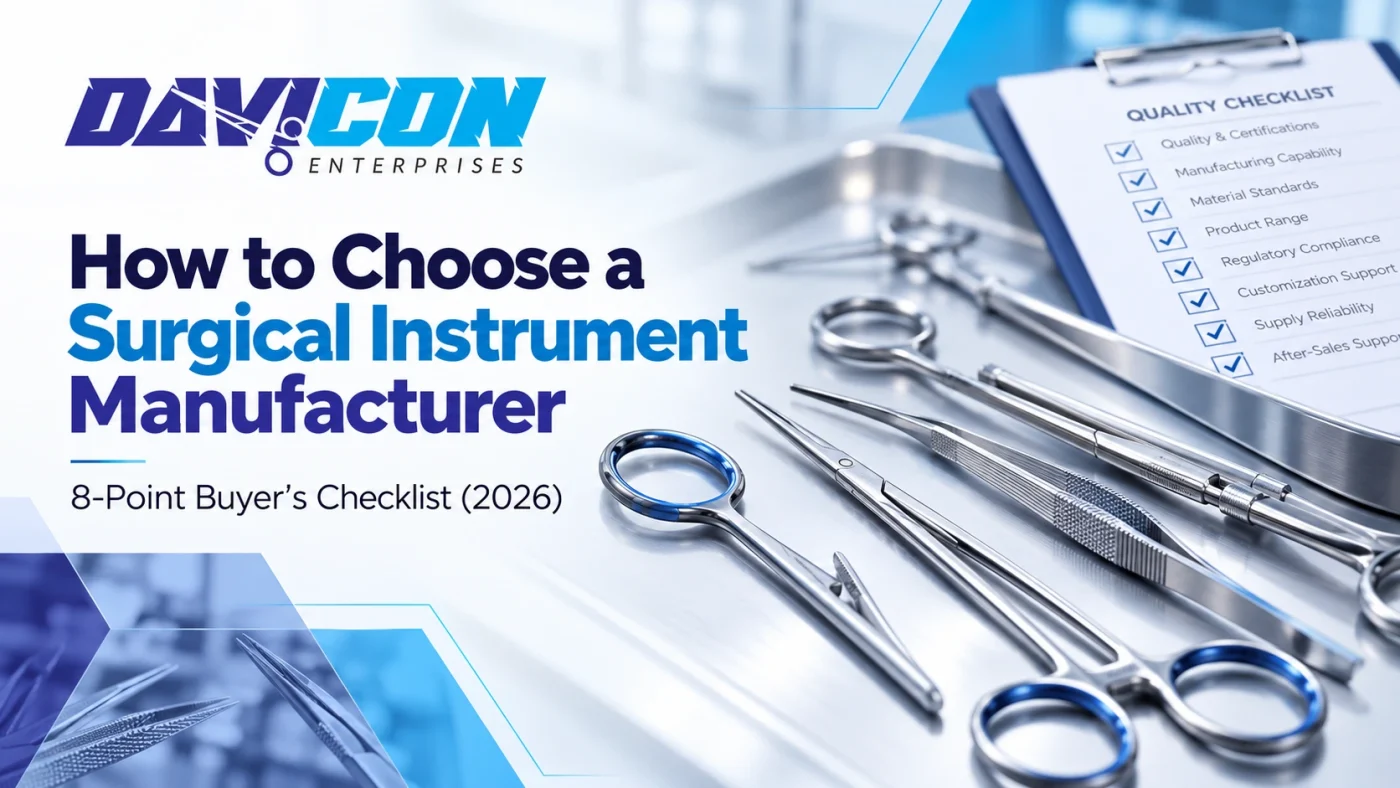
To choose a surgical instrument manufacturer, look for four things first: valid ISO 13485 and CE documents, medical-grade stainless steel with a clear standard, samples you can test, and clear answers on MOQ, lead time and after-sales support. Then check that the company really makes the instruments and is not just a trader.
This guide explains each step in simple words. You will also get a list of documents to ask for, questions to send before you order, red flags to avoid, and a scorecard you can use to compare suppliers.
Quick Answer: What to Check Before You Order
- Ask for a current ISO 13485 certificate and CE documents, and verify them.
- Ask which steel grade is used and which standard it follows (for example ISO 7153-1 or ASTM F899).
- Find out if the company is the real manufacturer, an OEM partner or a distributor.
- Order samples and inspect them before a bulk order.
- Get MOQ, lead time, packaging and shipping terms in writing.
- Ask about repair, replacement and complaint handling.
- Compare two or three suppliers with the same scorecard.
Why Choosing the Right Surgical Instrument Manufacturer Matters
A surgical instrument is not a normal product. A surgeon holds it, a patient is treated with it, and a hospital sterilizes it again and again. So the maker you choose matters more than the price on the quote.
A scissor that does not cut cleanly, a forceps whose tips do not meet, or a retractor that bends can slow a procedure and add risk. Good manufacturers control material, machining, finishing and inspection so that each instrument works the same way every time.
The real cost is more than the price
A very cheap instrument may rust, lose its edge or break early. Then you pay for repairs, replacements and lost time in the operating room. A fair price from a reliable maker is often cheaper over the full life of the instrument.
Rules and import risk
Medical devices are regulated in most countries. If your supplier cannot give proper documents, your shipment may be delayed at customs, or you may not be able to sell the product in your market. Rules differ by country and by device class, so always confirm the details with your own regulatory team.
Manufacturer vs Supplier vs Distributor: Know Who You Are Buying From
People often use the word “supplier” for very different businesses. Before you talk about price, ask the company what its role is.
| Type | What they do | What to ask |
|---|
| Direct manufacturer | Makes the instruments in its own factory | Can I see the production process and QC records? |
| OEM / ODM partner | Makes instruments to your design or under your brand | Who owns the design, and can you add my label or laser marking? |
| Trader or distributor | Buys from other factories and resells | Which factory makes the product, and who is responsible for quality and complaints? |
A trader is not always a bad choice. But if you want control over quality, customization and price, a direct manufacturer is usually the better fit.
8 Things to Check When Choosing a Surgical Instrument Manufacturer
1. Quality certifications
Start with ISO 13485. It is the quality management standard made for medical device companies. It shows that the company has a documented system for design, production, inspection and corrections.
Next, check CE documents if you sell in Europe. CE marking for medical devices follows the EU Medical Device Regulation (EU) 2017/745. If you sell in the United States, ask what the company’s FDA registration and device listing status is for the products you want.
A certificate is a starting point, not a guarantee. It should be current, issued to the right company name and address, and cover the product type you plan to buy.
2. Material grade and standards
“Surgical steel” is a sales term, not a legal grade. Ask for the exact alloy and the standard it follows.
- ISO 7153-1 lists materials for metallic surgical instruments.
- ASTM F899 covers stainless steels used for surgical instruments.
- Martensitic stainless steel (400-series) can be heat-treated, so it is common for cutting and holding instruments like scissors and forceps. It is magnetic.
- Austenitic stainless steel (such as 304 and 316L) resists corrosion well and is common for retractors and other tools that stay in contact with fluids. 316-type steel contains molybdenum, which helps against corrosion.
The right grade depends on the job. A good manufacturer can tell you why a grade was chosen for each instrument type.
3. Manufacturing process and quality control
Ask how the instrument is made, from raw material to packing. Look for these points:
- Material checks when steel arrives
- Forging, CNC machining or laser cutting with clear process control
- Heat treatment records for instruments that need hardness
- Hand finishing and polishing
- Inspection at several stages, not only at the end
- Batch or lot codes so each instrument can be traced
A maker who is proud of the process will explain it openly.
4. Product range and specialty fit
Check that the factory really makes the type of instrument you need. Plastic surgery retractors, ophthalmic micro instruments and orthopedic rongeurs need very different skills and tools. A wide catalog is good, but ask which categories are the company’s strongest.
5. Samples and testing
Never place a large first order without samples. Ask for a few pieces from normal stock, not specially made show pieces. Then test them using the steps in the next section.
6. MOQ, lead time and shipping
Ask for these in writing:
- Minimum order quantity (MOQ) for standard and custom items
- Normal lead time and what happens when the order is late
- Packaging method and labeling
- Shipping terms (such as EXW, FOB or DDP) and who pays for what
7. Customization options
If you need your own brand, ask about OEM and ODM service. Common requests include private label, laser marking, custom sets, kit bags, special sizes and custom packaging. Ask about the design approval steps, sample time and MOQ for custom items.
8. After-sales support
The relationship starts after delivery. Ask how the company handles damaged goods, wrong items, quality complaints, repairs and replacements. A clear written process is a good sign.
Documents to Request From a Surgical Instrument Manufacturer
Before you place an order, ask for these documents:
- ISO 13485 certificate
- CE documents or the declaration of conformity that applies to your product
- Material certificates or steel specification details
- A quality control or inspection report sample
- Packaging and labeling details
- Batch or traceability code explanation
- Company registration and address details
How to verify a certificate
- Check that the company name and address match the supplier you are talking to.
- Check the issue and expiry dates.
- Check the scope. It should include the kind of instruments you plan to buy.
- Check the issuing body’s name, and use its public lookup or contact it if you are unsure.
- Ask for the document in the same company name that will appear on your invoice.
Questions to Ask a Surgical Instrument Supplier
Send these questions by email. Clear and quick answers tell you a lot.
- Are you the manufacturer, an OEM partner or a trader?
- Which certificates do you hold, and can you send copies?
- Which stainless steel grades do you use, and to which standard?
- How do you inspect instruments during and after production?
- Can you provide batch or lot traceability?
- What is your MOQ for standard and custom items?
- What is your normal lead time, and how do you handle delays?
- Can you send samples from regular stock?
- Do you offer private label or laser marking?
- How do you pack instruments for export?
- What happens if I receive a faulty item?
- Can you share references or export markets you already serve?
How to Inspect a Sample Instrument
When samples arrive, take your time. A simple check can show problems early.
- Look at the finish. The surface should be even, with no rough spots, pits or sharp burrs.
- Test the action. Scissors should open and close smoothly. Forceps tips should meet exactly. Ratchets should lock and release cleanly.
- Check the joints. A box lock should feel firm, not loose or stiff.
- Check the marking. Look for the manufacturer name, a code you can trace and the right size or pattern marking.
- Test cutting edges. Use a suitable test material and check that the cut is clean.
- Do not rely on a magnet test alone. Some good instrument steels are magnetic and some are not, so a magnet cannot tell you quality by itself.
- Test cleaning and sterilization. Follow your own process and look for stains, rust spots or damage after repeated cycles.
If you buy for a hospital or clinic, let your sterile processing team or clinical staff check the samples too.
Red Flags to Avoid
- The company will not share certificates or only sends blurry copies.
- The company says “surgical grade” but cannot name the alloy or standard.
- The price is far below every other quote.
- The company refuses samples or only sends special show pieces.
- The company cannot say if it is a manufacturer or a trader.
- Answers about MOQ, lead time or returns are vague.
- There are no batch codes or product markings.
- Every message ends with pressure to pay fast.
Surgical Instrument Manufacturer Scorecard
Use the same table for each supplier. Give each line a score from 1 to 5, multiply by the weight and add up the total.
| What you check | Weight | Score (1–5) | Notes |
|---|
| Certificates and compliance | 25% | | |
| Material and standards | 20% | | |
| Quality control and inspection | 20% | | |
| Sample quality and product fit | 10% | | |
| Lead time and MOQ | 10% | | |
| Customization (OEM / ODM) | 5% | | |
| After-sales support | 10% | | |
You can change the weights to match your needs. For example, a distributor who wants private label may give customization a higher weight.
Sourcing Surgical Instruments From Sialkot, Pakistan
Sialkot, in Punjab, Pakistan, is a well-known centre for surgical instrument making. Many workshops and factories in the city make instruments for buyers around the world, so buyers have many choices. That is useful, but it also means quality can differ a lot from one company to another.
What export buyers should verify
- Is the company the actual factory or a trading office?
- Does it hold valid ISO 13485 and CE documents for the instruments you need?
- Can it show its production and inspection steps?
- Has it shipped to markets like yours, such as the USA, UK or Europe?
- Are payment, shipping and documents clear and in writing?
Use the same checklist for a Sialkot company that you would use for a company in any other country.
How Davicon Surgical Approaches Quality and Customization
Davicon Surgical has exported surgical instruments from Sialkot since 2000, with an office in the RAK Free Zone, United Arab Emirates. We serve healthcare buyers in the USA, UK, Europe and Asia.
Our range covers plastic surgery, general surgery, ENT, ophthalmology, orthopedic and neuro, cardiothoracic, micro surgery, urology, OB/GYN, dental, dermal and podiatry, and hair transplant instruments, as well as liposuction cannulas.
We also work on OEM and ODM orders, including custom specifications, CNC machining and hand-finished stainless steel instruments. You can read more about our Quality Policy and Manufacturing Process. For care after purchase, see our guide on Surgical Instrument Care and Handling.
[Add here only what you can prove: certificate names and numbers, issuing bodies, and valid dates for ISO 13485 and CE. Add a real photo of the factory or QC area.]
We are happy to send documents, answer your questions and share samples so that you can compare us fairly with other suppliers.
Frequently Asked Questions
How do I choose a surgical instrument manufacturer?
Check the company’s certificates (ISO 13485 and CE), steel grade and standards, inspection process, sample quality, MOQ and lead time, and after-sales support. Also confirm whether the company is a real manufacturer or a trader. Compare two or three suppliers with the same scorecard.
What certificates should a surgical instrument manufacturer have?
At a minimum, ask for ISO 13485 and CE documents that fit your product and market. If you sell in the United States, also ask about FDA registration and device listing. Always check that the certificate is current and matches the company name and address.
What is ISO 13485 and why does it matter?
ISO 13485 is a quality management standard for medical device companies. It shows that a company has a documented system for production, inspection and correction. It does not guarantee every product is perfect, but it is a strong sign of a controlled process.
Which stainless steel is best for surgical instruments?
There is no single best steel. Martensitic 400-series steels are common for cutting and holding tools because they can be hardened. Austenitic grades such as 316L are common where corrosion resistance matters more. Ask the manufacturer why a grade was chosen for each instrument.
What is the difference between a manufacturer and a distributor?
A manufacturer makes the instruments in its own facility and controls quality. A distributor buys from other factories and resells. A distributor may offer quick delivery and a mixed range, but you have less control over materials and production.
Can I get private label or OEM surgical instruments?
Many manufacturers offer OEM or private label service, including brand marking, custom packaging and custom sets. Ask about design approval, sample time and MOQ for custom items before you commit.
What MOQ do surgical instrument manufacturers usually ask for?
It depends on the instrument, the material and whether the item is standard or custom. Standard items often have a lower MOQ than custom ones. Always ask for the MOQ in writing for each item type.
How do I check if a supplier’s CE or ISO certificate is real?
Check the company name, address, dates and scope. Then confirm the certificate with the issuing body using its public lookup or contact details. If a supplier avoids this step, treat it as a red flag.
Conclusion
Choosing a surgical instrument manufacturer is a quality decision, not just a price decision. Check certificates, steel, process, samples, lead time and support, and use the same scorecard for every supplier. Take your time with samples. A careful check before the first order can save you from costly problems later.
If you want to compare instruments or see our documents, request our catalog or send us a bulk quote request.
This guide is for general buying information. Rules differ by country and device class, so confirm requirements with your regulatory or quality team before you import or sell medical devices.