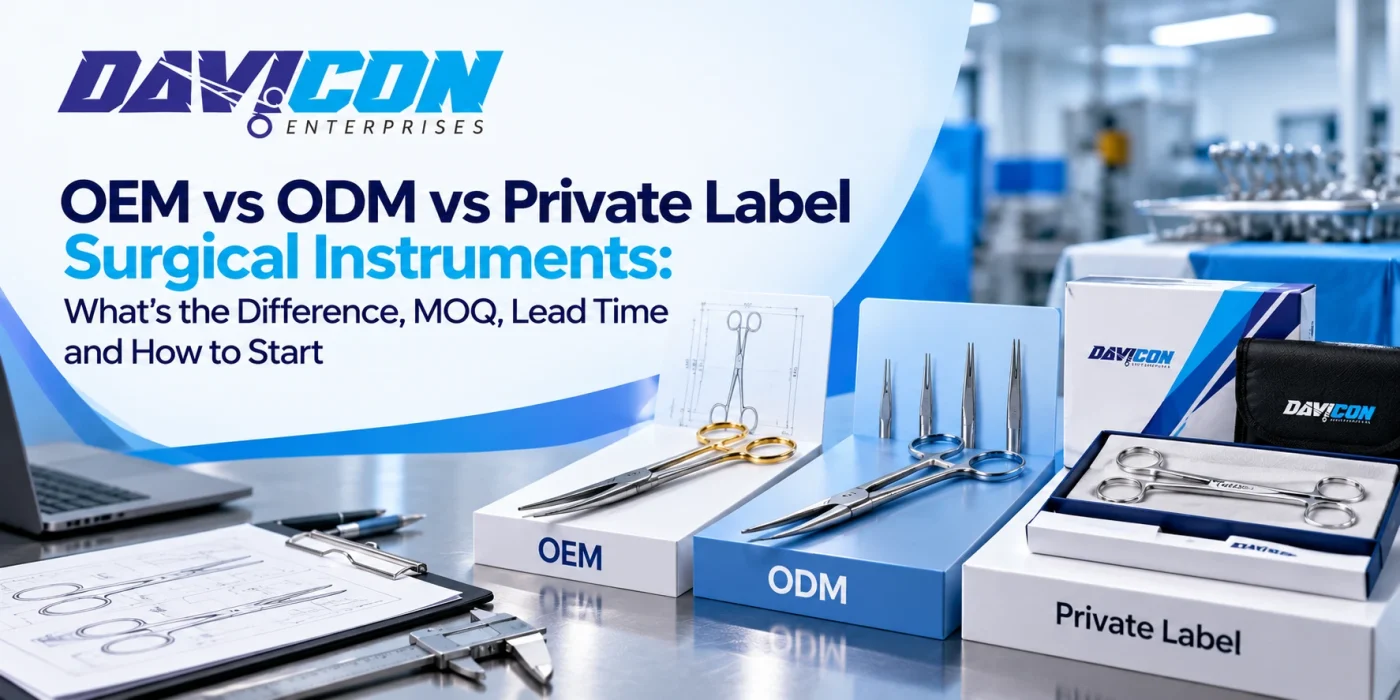
More distributors, clinics and online sellers now want to sell surgical instruments under their own brand. The idea is simple, but the words used in this business are not. Suppliers talk about OEM, ODM, private label and white label, and often mean different things by each one. Before you place an order, you need to know exactly what you are buying, how many pieces you must order, how long it will take, and who is legally responsible for the product. At Davicon Surgical, we have made and exported surgical, dental and beauty instruments since 2000, and many of our buyers start with these exact questions. This guide explains private label surgical instruments, OEM and ODM in plain words, with real-world MOQ and lead time ranges and a step-by-step plan to launch your own brand.
Quick Answer: Private label means putting your brand on a manufacturer’s existing instruments. ODM means the manufacturer’s own design, changed to suit you and sold under your brand. OEM means the manufacturer makes instruments to your own design or specification. Private label is the fastest and lowest-risk way to start. OEM gives you the most control but needs larger orders and more time.
What Are Private Label Surgical Instruments?
Private label surgical instruments are standard instruments made by a manufacturer and sold under the buyer’s brand name. The instrument pattern stays the same. What changes is the branding.
Common private label options include:
- Your logo or brand name laser etched on the instrument
- Your own catalog or product codes
- Custom pouches, boxes and labels
- Color-coded handles or rings, where available
- Instructions for use (IFU) leaflets with your brand details
Example: A dental supply company in the UK chooses 40 standard dental instruments from a manufacturer’s range. The manufacturer etches the company’s logo on each one and packs them in the company’s branded boxes. The company sells them as its own product line.
Best for: Distributors, startups and online sellers who want their own brand quickly, without design or tooling costs.
What Are OEM Surgical Instruments?
OEM (Original Equipment Manufacturer) surgical instruments are made to the buyer’s own design, drawing or sample. The buyer decides the specification, and the manufacturer builds it.
An OEM order usually includes:
- A technical drawing, a physical sample or a detailed written specification
- The exact length, tip shape, jaw pattern, ratchet type and finish
- The steel grade and hardness required
- Approval of a pre-production sample before full production
Example: A medical device company has designed a special retractor for its own surgical system. It sends the drawing to a manufacturer, approves a sample, and then orders regular production runs.
Best for: Established brands, device companies and buyers with a unique design they want to own.
What Are ODM Surgical Instruments?
ODM (Original Design Manufacturer) surgical instruments are based on the manufacturer’s own design, modified to suit the buyer. The manufacturer has already done the design work, and the buyer asks for changes.
Typical ODM changes include:
- A different length or blade size
- A new finish, such as matte, mirror or black coating
- Tungsten carbide inserts added to scissors or needle holders
- Modified tips, teeth or handle shapes
Example: A veterinary supplier likes a manufacturer’s standard needle holder but wants it 2 cm longer with tungsten carbide jaws. The manufacturer adapts its existing design and makes it under the supplier’s brand.
Important point about ownership: In ODM work, the original design usually stays with the manufacturer unless your contract says otherwise. If you want exclusive rights to a modified design, put it in writing.
Best for: Buyers who want something different from the standard catalog, without paying for a full design from scratch.
OEM vs ODM vs Private Label Surgical Instruments: Side-by-Side Comparison
| Factor | Private Label | ODM | OEM |
|---|
| Who designs the instrument | Manufacturer | Manufacturer, adapted for buyer | Buyer |
| Who owns the design | Manufacturer | Usually manufacturer, unless agreed | Buyer |
| Level of customization | Logo, packaging, labels | Size, finish, inserts, small design changes | Full control |
| Typical MOQ | Lowest | Medium | Highest |
| Typical lead time | Shortest | Medium | Longest |
| Upfront cost | Low | Medium | High (samples, dies, tooling) |
| Business risk | Low | Medium | Higher |
| Best for | New brands, distributors, online sellers | Growing brands wanting a difference | Established brands with unique designs |
White Label vs Private Label Surgical Instruments
These two terms are often mixed up. White label usually means a generic product sold to many buyers, often with little or no branding, so several companies may sell the exact same item. Private label usually means the product carries your brand, with your logo and packaging, and sometimes comes with exclusive rights in your market. If your goal is to build a recognized brand, private label is the better route.
MOQ for Private Label Surgical Instruments and OEM Orders
MOQ (Minimum Order Quantity) is the smallest order a manufacturer will accept for one item or one order. For private label surgical instruments, MOQ is usually lower than for OEM, because no new tooling is needed.
What Affects MOQ
- Pattern: standard catalog patterns need lower quantities than new designs
- Forging dies: a new design may need a new die, which only makes sense across larger runs
- Steel grade: special grades may need minimum material purchases
- Finish and coatings: extra processes such as black coating or gold plating add setup time
- Custom packaging: printed boxes and pouches often have their own minimums
Typical MOQ Ranges
| Order type | Typical MOQ per item |
|---|
| Private label (logo etching on standard patterns) | Often from 50 to 100 pieces per pattern |
| ODM (modified design) | Often from 100 to 300 pieces per pattern |
| OEM (new design, new dies) | Often from 300 to 500 pieces or more per pattern |
These are typical industry ranges, not fixed rules. Every manufacturer sets its own MOQ, so always ask for exact numbers for your items.
How to Lower Your MOQ
- Choose existing patterns from the catalog
- Use standard packaging at first, then move to custom boxes later
- Ask whether a mixed order (many patterns, smaller quantity each) is accepted
- Start with a trial order, then increase as sales grow
Lead Time for Private Label Surgical Instruments, OEM and ODM
Lead time is how long it takes from order confirmation until your instruments are ready to ship. Do not confuse it with total delivery time, which also includes shipping and customs clearance.
Typical Production Lead Times
| Order type | Typical production lead time |
|---|
| Private label on standard patterns | About 3 to 6 weeks |
| ODM (modified designs) | About 6 to 10 weeks |
| OEM (new designs and dies) | About 8 to 12 weeks or more |
Add shipping time: air freight usually takes a few days to two weeks, while sea freight can take several weeks depending on the destination.
The Production Journey, Step by Step
- Sample and approval: the manufacturer makes a sample for you to check and approve
- Forging: steel is shaped into the basic instrument form
- Machining and filing: jaws, teeth, ratchets and joints are cut and shaped
- Heat treatment: the steel is hardened to the correct level
- Finishing: grinding, polishing and any special finish
- Passivation: a chemical process that strengthens rust resistance
- Inspection: each instrument is checked for function and finish
- Logo etching and packing: your brand is applied and items are packed
- Shipping: by air or sea, with export documents
What Causes Delays
- Changes after the sample is approved
- Late approval of logo artwork or packaging designs
- New dies for OEM orders
- Missing documents or unclear specifications
Costs to Expect with Private Label Surgical Instruments
Understanding costs early helps you set the right selling price.
Unit cost depends on:
- The instrument type and complexity
- Steel grade and finish
- Tungsten carbide inserts or coatings
- Order quantity (larger orders usually lower the unit price)
One-time costs may include:
- Samples
- New forging dies (mainly OEM)
- Logo setup for laser etching
- Printing plates or design work for custom packaging
Costs buyers often forget:
- Freight and insurance
- Import duties and taxes in your country
- Regulatory registration costs
- Incoming inspection and storage
Regulatory Responsibilities for Private Label Surgical Instruments
This is the part most buyers overlook. When your name goes on a medical device, you may take on legal responsibilities. The rules depend on your country, so treat this section as a general guide, not legal advice.
Who Is the Legal Manufacturer?
The legal manufacturer is the company named as the manufacturer on the label, and it is responsible for the product’s safety and compliance. In some private label setups, the original maker stays the legal manufacturer and your brand appears as the distributor. In others, your company becomes the legal manufacturer. Decide this before you design your labels.
European Union (EU MDR)
Under the EU Medical Device Regulation, a distributor or importer that places a device on the market under its own name can take on the obligations of a manufacturer. There are exceptions where the original manufacturer agrees to stay responsible and is named on the label. If you sell in Europe, agree on these roles in writing and check that the correct CE documentation is in place.
United States (FDA)
In the US, when the manufacturer applies your private label and you do not repackage or relabel the device, the FDA generally treats you as a distributor. If you relabel or repackage instruments yourself, you may be treated as a manufacturer, with registration, listing and quality system duties. Many basic hand-held surgical instruments are low-risk devices, but you should confirm the classification for each item.
Documents to Ask Your Manufacturer For
- ISO certificate (ideally ISO 13485 for medical devices)
- CE marking documents, where relevant
- Material certificates showing the steel grade
- Instructions for use (IFU) and cleaning and sterilization guidance
- Inspection or test reports for your order
How to Start Your Own Private Label Surgical Instruments Brand
Here is a simple roadmap that works for most new brands.
- Pick your niche. Dental, veterinary, plastic surgery, beauty and podiatry each have different buyers and price levels. Focus on one first.
- Choose your model. Start with private label to keep risk low. Move to ODM or OEM once you know what sells.
- Shortlist manufacturers. Check experience, certifications, product range and communication.
- Request samples. Test the instruments yourself, or ask clinicians you trust to try them.
- Approve specifications and artwork. Confirm sizes, finishes, logo position and packaging in writing.
- Place a trial order. Keep it small enough to manage but large enough to test the market.
- Inspect on arrival. Check a sample from every batch for function, finish and correct branding.
- Scale up. Reorder your best sellers, add new items and consider exclusive ODM designs.
At Davicon Surgical, most new private label surgical instruments clients follow this same path. They start with a focused range of standard patterns, test their market, and then expand into custom finishes and exclusive designs.
How to Choose a Manufacturer for OEM and Private Label Surgical Instruments
Use this checklist before you sign:
- Experience: how many years have they made and exported instruments?
- Certifications: do they hold ISO and CE, and can they show the certificates?
- Materials: can they confirm steel grades with material certificates?
- In-house processes: do they control forging, finishing, heat treatment and passivation?
- Quality control: is every instrument inspected, or only samples?
- Sample policy: will they make samples before production?
- IP and NDA: will they protect your designs and brand?
- Communication: do they reply clearly and quickly?
- Shipping terms: do they offer FOB, CIF or delivered pricing?
- References: can they share examples of current private label clients, with permission?
Why Sialkot Is a Trusted Source of Private Label Surgical Instruments
Sialkot, in Pakistan, has been making surgical instruments for more than a century and is one of the world’s best-known centers for hand-held instruments. Thousands of skilled workers and hundreds of workshops in the city specialize in forging, filing, polishing and finishing. That depth of skill is why many international brands source OEM and private label instruments from the region. Quality still differs from one maker to another, so it’s important to choose a manufacturer with proper certification, controlled processes and a clear inspection system.
Common Mistakes When Ordering Private Label Surgical Instruments
- Vague specifications: “a good needle holder” is not a spec. Give the length, jaw type, inserts and finish.
- Skipping samples: always approve a sample before full production.
- No IP clause: if you pay for a design change, agree in writing who owns it.
- Buying on price alone: very cheap instruments often use poor steel or skip passivation.
- Ignoring the legal manufacturer question: sort out labeling and regulatory roles before printing packaging.
- No incoming inspection: check every shipment before it reaches your customers.
Final Thoughts on OEM, ODM and Private Label Surgical Instruments
The right model depends on where your business is today. Private label lets you launch your own brand quickly with low risk. ODM gives you something different from the standard catalog. OEM gives you full control over a unique design. For most new brands, private label surgical instruments are the smartest first step, because they let you test your market before you invest in tooling and custom designs. At Davicon Surgical, we help distributors and brands around the world build their own instrument lines, from logo etching and custom packaging to modified and custom designs, with every piece hand-finished and inspected. Browse our full product range or contact our team to discuss samples, MOQ and lead times for your brand.
FAQs
What is the difference between OEM and private label surgical instruments?
Private label instruments are the manufacturer’s standard designs sold under your brand. OEM instruments are made to your own design or specification. Private label is faster and cheaper to start, while OEM gives you full control and ownership of the design.
What is the minimum order quantity for private label surgical instruments?
It depends on the manufacturer and the instrument. Private label orders on standard patterns often start from about 50 to 100 pieces per pattern. ODM and OEM orders usually need larger quantities because of design and tooling work.
How long does it take to make OEM surgical instruments?
OEM production often takes about 8 to 12 weeks or more, because it includes sampling, approval and sometimes new forging dies. Private label orders on standard patterns are usually faster, at around 3 to 6 weeks before shipping.
Can I put my company logo on surgical instruments?
Yes. Laser etching is the most common method. It creates a permanent, clean mark that survives cleaning and autoclaving. You can also brand the packaging, labels and instruction leaflets.
Who is responsible for CE marking or FDA listing on private label instruments?
It depends on who is named as the legal manufacturer on the label and on the rules in your market. In some cases the original manufacturer stays responsible, and in others the brand owner takes on manufacturer duties. Always confirm with a regulatory advisor in your country.
Do I own the design in an ODM agreement?
Not automatically. In most ODM arrangements the base design belongs to the manufacturer. If you want exclusive rights to a modified design, include this clearly in your contract.
Can I mix different instruments in one private label order?
Many manufacturers accept mixed orders, especially for standard patterns. This helps new brands offer a wider range without ordering large amounts of each item. Ask your manufacturer about their mixed-order policy.