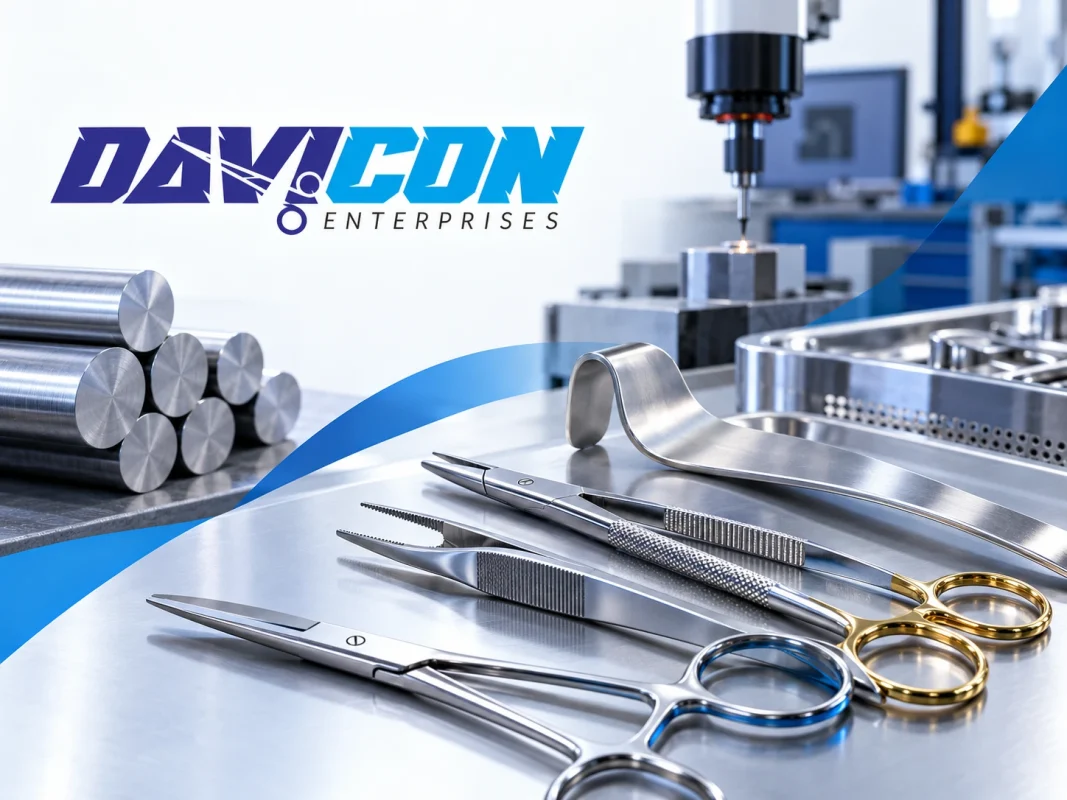
Every surgical instrument starts as a piece of steel. That steel decides whether scissors stay sharp after hundreds of cuts, whether forceps hold their grip, and whether a retractor keeps its shine after years of autoclaving. Still, most buyers are told only one thing: “It’s surgical steel.” That label tells you very little. In this guide, the team at Davicon Surgical explains surgical stainless steel grades in plain words. You will learn what 304, 316L and the 400-series grades really are, how they differ, and which grade suits forceps, scissors, retractors and other instruments. We have made and exported surgical instruments since 2000, and this guide draws on what we see on the workshop floor every day.
Quick Answer: There is no single “surgical steel.” Cutting instruments like scissors work best in hardened 420 or 440 stainless steel because it holds a sharp edge. Forceps and needle holders usually use 410 or 420 steel for strength and spring. Retractors and other non-cutting instruments often use 304 or 316L steel for the best rust resistance.
What Is Surgical Stainless Steel? (Surgical Stainless Steel Grades Defined)
Surgical stainless steel is a general name for stainless steel grades that are suitable for medical instruments or devices. It is not one material. It is a family of steels, and each grade has a different mix of iron, chromium, nickel, carbon and other elements.
All stainless steel contains at least about 10.5% chromium. The chromium forms a very thin, invisible layer on the surface, called the passive layer, which protects the metal from rust. Small changes in the other elements change how hard, strong or rust-resistant the steel becomes.
Is “Surgical Steel” a Legally Defined Term?
No. “Surgical steel” has no single official definition. Any seller can use the phrase, even on cheap jewelry or kitchen tools. That is why a serious buyer should never accept “surgical steel” alone as proof of quality. The real proof is the grade number (such as 410, 420 or 316L) and the standard the steel is made to.
The Standards That Actually Matter: ASTM F899, ISO 7153-1 and ASTM F138
- ASTM F899 is the American standard for wrought stainless steels used to make surgical instruments. It sets chemical limits and groups the steels into classes: austenitic, martensitic, precipitation hardening and ferritic.
- ISO 7153-1 is the international standard that lists metals suitable for surgical instruments and which kinds of instruments they suit.
- ASTM F138 covers 316L steel for implants. It is about material that stays inside the body, not about scissors or forceps.
When you see one of these standards on a material certificate, you know exactly what you are getting.
The Two Main Families of Surgical Stainless Steel Grades: Austenitic vs Martensitic
To understand surgical stainless steel grades, start with the two main families. Almost every hand-held instrument is made from one of them.
300-Series (Austenitic): 304 and 316L
Austenitic steels contain a lot of chromium and nickel. They have excellent rust resistance and are easy to shape. However, heat treatment cannot harden them. They stay fairly soft, which means they cannot hold a sharp cutting edge for long.
400-Series (Martensitic): 410, 420 and 440
Martensitic steels have more carbon and little or no nickel. Their main strength is that heat treatment can make them very hard. This is why they hold a sharp edge and keep their shape under pressure. The trade-off is that they resist rust less than the 300-series, so finishing and care matter more.
Why Some Surgical Instruments Are Magnetic
People are often surprised when a magnet sticks to their scissors. This is normal. Martensitic 400-series steel is magnetic by nature. Austenitic 300-series steel is mostly non-magnetic, although it can become slightly magnetic after heavy bending or shaping. A magnet test tells you which family a steel belongs to, not whether it is good or bad.
304 vs 316L vs 400-Series Surgical Stainless Steel Grades: Comparison Table
| Grade | Family | Key elements | Hardness after processing (approx.) | Rust resistance | Edge holding | Magnetic | Best for |
|---|
| 304 | Austenitic | About 18% chromium, 8% nickel | Low, cannot be heat hardened | Very good | Poor | Mostly no | Retractor blades, bowls, trays, cannulas |
| 316L | Austenitic | Chromium, nickel, 2 to 3% molybdenum, very low carbon | Low, cannot be heat hardened | Excellent | Poor | Mostly no | Retractors, cannulas, parts exposed to salt and fluids |
| 410 | Martensitic | About 12% chromium, low carbon | Medium to high | Good | Fair | Yes | Forceps, clamps, hinged instruments |
| 420 | Martensitic | About 12 to 14% chromium, medium carbon | High (around 50 HRC or more for cutting tools) | Good | Very good | Yes | Scissors, needle holders, forceps |
| 440 (A/B/C) | Martensitic | About 16 to 18% chromium, high carbon | Very high | Fair to good | Excellent | Yes | Fine scissors, blades, chisels, osteotomes |
Note: Hardness values are typical ranges. The final hardness depends on the heat treatment chosen for each instrument.
304 Stainless Steel for Surgical Instruments
304 is the most widely used stainless steel in the world. It is often called “18/8” steel because it contains about 18% chromium and 8% nickel.
Strengths:
- Strong resistance to rust and staining
- Easy to bend, shape and polish
- Cost-effective
Limits:
- Heat treatment cannot harden it
- Cannot hold a sharp edge
- Can bend under heavy force
Where 304 makes sense: retractor blades, instrument trays, kidney dishes, bowls, cannula tubes and handles. In short, it suits parts that need to stay clean and rust-free but do not need to cut or grip hard.
316L Surgical Steel: When It Is Worth Choosing
316L is a step up from 304 in rust resistance. It adds 2 to 3% molybdenum, which helps the steel resist pitting from salt, blood and harsh cleaning chemicals. The “L” stands for low carbon, which protects the steel’s rust resistance after welding.
Strengths:
- Excellent resistance to pitting and corrosion
- Good for long contact with body fluids
- Widely used in implants when made to ASTM F138
Limits:
- Like 304, it cannot be hardened by heat
- Not suitable for scissors or other cutting instruments
- Costs more than 304
An important point: many websites say 316L is “the best surgical steel.” For implants and some non-cutting parts, it can be. For scissors and many forceps, it is the wrong choice because it is too soft. The best grade is the one that matches the instrument’s job.
316L vs 316LVM: 316LVM is 316L melted under vacuum to make it cleaner and more consistent. It is mainly used for implants and high-end body jewelry, not for everyday hand instruments.
400-Series Surgical Stainless Steel Grades (410, 420 and 440)
The 400-series does most of the hard work in the operating room. These martensitic surgical stainless steel grades can be heat treated to the right balance of hardness and toughness.
410 Stainless Steel: Strong and Reliable for Hinged Instruments
410 has lower carbon than 420, so it is tougher and less brittle, though not as hard. This makes it a good fit for instruments that flex, lock and take repeated stress, such as hemostatic forceps and clamps with ratchets.
420 Stainless Steel Surgical Instruments: The Industry Workhorse
420 is the most common grade for quality surgical instruments. With proper heat treatment, it reaches a high hardness and holds a sharp edge well, while keeping good rust resistance. Many scissors, needle holders and forceps are made from 420.
440 Stainless Steel: Maximum Hardness for Fine Cutting Edges
440 (especially 440C) has the most carbon of the common grades. It can reach very high hardness, which makes it ideal for fine cutting edges, blades, chisels and bone tools. It needs careful finishing and care because it resists rust a little less than 420.
Best Surgical Stainless Steel Grades by Instrument Type
| Instrument | Recommended grade | Why |
|---|
| Surgical scissors | 420 or 440, or tungsten carbide inserts | Holds a sharp edge through repeated cutting |
| Dissecting and tissue forceps | 410 or 420 | Good spring, strength and grip |
| Hemostats and clamps | 410 or 420 | Tough hinges and ratchets that resist cracking |
| Needle holders | 420, often with tungsten carbide jaws | Firm grip on needles without wearing down |
| Retractors (hand-held and self-retaining) | 304, 316L or 410/420 | Rust resistance for blades, strength for frames |
| Cannulas and tubes | 304 or 316L | Corrosion resistance and easy shaping |
| Osteotomes, chisels, curettes | 440 or hardened 420 | Very hard working edge |
Best Steel Grade for Surgical Forceps
Forceps need to open and close thousands of times without bending or losing their spring. 410 and 420 give the right mix of strength and flexibility. Rust-resistant 300-series steel is too soft for fine tips, which can bend out of alignment.
Best Steel for Surgical Scissors
Scissors need the hardest steel. 420 and 440 hold a sharp edge much longer than 304 or 316L ever could. For heavy use, many surgeons choose scissors with tungsten carbide (TC) inserts on the blades. TC is even harder than steel, so it stays sharp longer and is easy to spot by its gold handles.
Best Steel Grade for Retractors
Retractors hold tissue open and do not cut, so edge sharpness does not matter. What matters is strength, stiffness and rust resistance. Simple hand-held retractor blades work well in 304 or 316L. Self-retaining retractors with ratchets and screws often use 410 or 420 for the moving parts.
Needle Holders, Micro Instruments and Cannulas
Needle holders grip curved needles under pressure, so 420 steel with tungsten carbide jaw inserts is a popular choice. Micro surgery instruments need hardened 400-series steel so their very fine tips stay aligned. Cannulas, including liposuction cannulas, are often made from 304 or 316L tubing for rust resistance and smooth finishing.
How Surgical Stainless Steel Grades Affect Sterilization and Corrosion
Each grade reacts differently to cleaning and autoclaving.
- Passivation matters. After manufacturing, good instruments go through passivation. This chemical process cleans the surface and strengthens the protective chromium layer. It is especially important for 400-series instruments.
- Chlorides are the enemy. Salt water, saline, blood left to dry and some bleach-based cleaners can cause pitting and rust spots, even on good steel.
- Detergents make a difference. Use cleaners made for surgical instruments, ideally neutral or mildly alkaline or enzymatic products, and follow the maker’s dilution guide.
- Dry fully before storage. Water left in hinges and box locks is a common cause of rust on forceps and needle holders.
- Separate metals. Do not process damaged or rusty instruments with good ones, because rust can transfer.
Even the best grade will fail with poor care. A well-made 420 instrument that is cleaned and dried correctly can last for many years.
How to Verify Surgical Stainless Steel Grades Before You Buy
Many low-cost instruments on the market do not meet their claims. Before you buy, use this simple checklist. It is the same checklist our quality team at Davicon Surgical uses when we review raw material and finished instruments for our surgical stainless steel grades.
- Ask for a material certificate. It should name the exact grade (for example, AISI 420) and the standard it meets.
- Look for a standard. ASTM F899 or ISO 7153-1 compliance shows the steel is suitable for surgical instruments.
- Check certifications. Look for CE marking and ISO-certified quality management, such as ISO 13485 for medical devices.
- Ask about heat treatment and passivation. A good supplier can explain how instruments are hardened and finished.
- Inspect the finish. Hinges should move smoothly, tips should meet perfectly, and there should be no pits, cracks or rough spots.
- Check the markings. Quality instruments are usually laser marked with the brand, the “stainless” mark and often a country of origin.
- Test the edge. Scissors should cut cleanly along the full length of the blade without folding the material.
Common Myths About Surgical Stainless Steel Grades
Myth: 316L is always the best surgical steel.
Fact: 316L is excellent for implants and rust resistance, but it is too soft for scissors and many forceps. The best grade depends on the job.
Myth: If a magnet sticks, the instrument is low quality.
Fact: Most high-quality scissors and forceps are made from magnetic 400-series steel. Being magnetic is normal.
Myth: Surgical steel never rusts.
Fact: Stainless steel resists rust. It is not rust-proof. Poor cleaning, chlorides and wet storage can damage any grade.
Myth: “Surgical steel” on a label guarantees quality.
Fact: The term has no single legal definition. Always ask for the grade number and the standard.
Final Thoughts on Choosing Surgical Stainless Steel Grades
The right steel is not about choosing the most expensive or most famous grade. It is about matching the grade to the work the instrument has to do. Scissors need hard, edge-holding steel like 420 or 440. Forceps and clamps need the strength and spring of 410 or 420. Retractors and cannulas benefit from the rust resistance of 304 or 316L. Knowing these surgical stainless steel grades helps you buy smarter, avoid weak instruments and get longer service from every tool. At Davicon Surgical, we match each instrument to the right grade, then hand-finish and inspect it to international standards. If you are not sure which grade suits your needs, our team is happy to guide you. Browse our full range of surgical instruments or contact us for a quote today.
Frequently Asked Questions
Is 316L stainless steel better than 304 for surgical instruments?
316L resists rust and pitting better than 304 because it contains molybdenum. However, neither can be hardened, so neither suits scissors or fine cutting instruments. For retractors, trays and cannulas, 316L is a strong upgrade over 304.
What grade of stainless steel are surgical scissors made of?
Quality surgical scissors are usually made from hardened 420 or 440 stainless steel. These grades hold a sharp edge for a long time. Premium scissors often add tungsten carbide inserts for even longer sharpness.
Is surgical steel the same as stainless steel?
Surgical steel is a type of stainless steel, but the term is not officially defined. Any stainless grade can be called “surgical.” The real difference lies in the grade number and whether it meets standards like ASTM F899 or ISO 7153-1.
Why do surgical instruments rust?
Instruments usually rust because of dried blood, salt or saline, harsh cleaning chemicals, or water left in hinges after cleaning. Damaged surfaces and contact with already rusty instruments can also cause rust spots.
Are surgical instruments supposed to be magnetic?
Yes, most of them. Scissors, forceps and needle holders are often made from 400-series martensitic steel, which is magnetic. Austenitic 304 and 316L are mostly non-magnetic.
What does ASTM F899 cover?
ASTM F899 is the standard specification for wrought stainless steels used to make surgical instruments. It sets chemical requirements and groups steels into austenitic, martensitic, precipitation hardening and ferritic classes.